
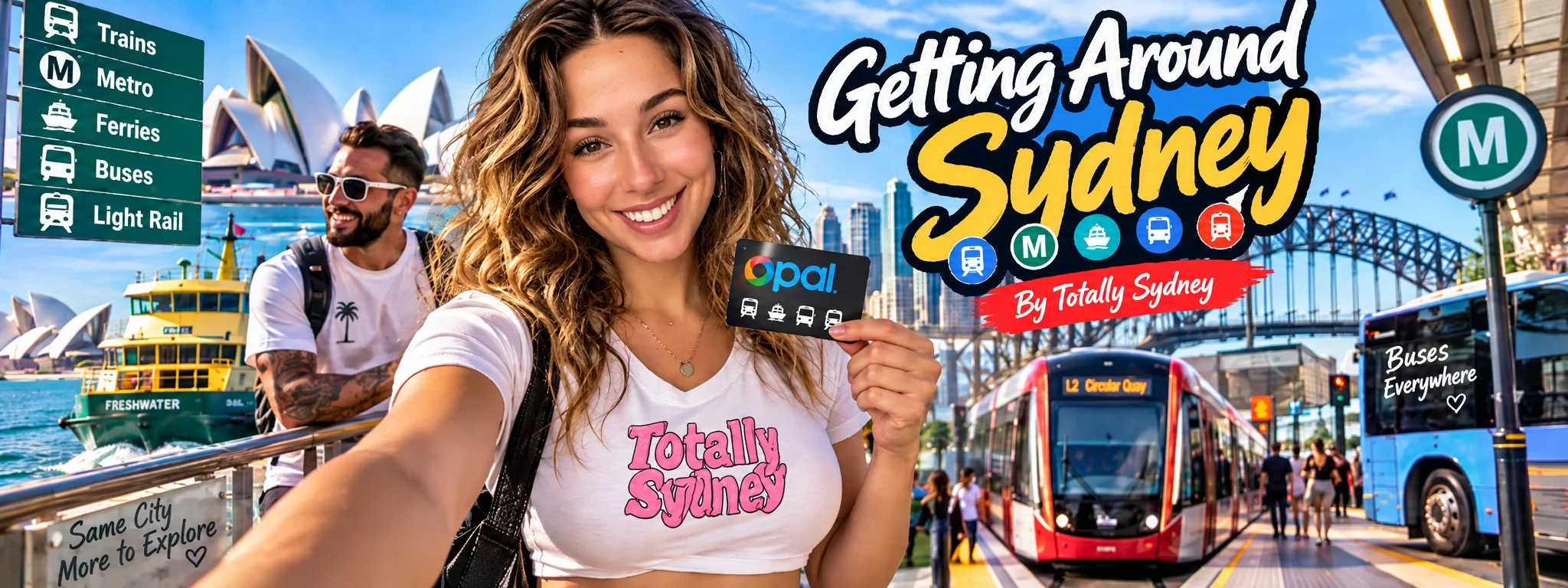
Sydney is much easier to get around than its size suggests. For most visitors, the useful network is a mix of Metro, suburban trains, buses, ferries and light rail, all using the same Opal fare system. You do not need to understand every line before you arrive; you mainly need to know how to pay, when a ferry is smarter than a bus, and which journeys carry special charges.
Quick answer for most adult visitors
Use the same contactless Visa, Mastercard or American Express card — or the same phone/watch wallet — every time you tap on and tap off. Adult contactless users receive the same standard Opal fares, transfer discounts and travel caps as an Adult Opal card. Do not swap between your physical card and the digital version of that card mid-journey.
If you are travelling with children, hold an eligible concession, or simply prefer a prepaid transport card, read our separate Sydney Opal Card and transport fares guide. This page is about how to move around the city efficiently.
Sydney's public transport in one table
| Mode | Best for | Main limitation |
|---|---|---|
| Metro | Fast cross-city trips and major interchanges | Does not cover every tourist area |
| Trains | CBD, airport, suburbs and longer trips | Some stations are a walk from the final attraction |
| Ferries | Manly, harbour suburbs and sightseeing while travelling | Weather and service changes can affect trips |
| Light rail | CBD, south-east, Inner West and Parramatta corridors | Slower than heavy rail over long distances |
| Buses | Beaches and areas without rail | Traffic can make journey times variable |
The useful habit is to choose the mode for the last part of your trip, not to become loyal to one system. For example, a train or Metro may do most of the distance quickly, followed by a short bus; a ferry may be slower on paper but place you exactly where you want to be while giving you a harbour trip at the same time.
How to pay: contactless or Opal
For an adult paying the standard fare, contactless is usually the least complicated option. Transport for NSW accepts American Express, Mastercard and Visa contactless cards and compatible devices. You receive the same adult Opal fares and core benefits as an Adult Opal card.
The important bit is consistency. If you tap on with your phone, tap off with that same phone. Your bank may treat the plastic card and the card stored in Apple Pay or Google Wallet as different payment tokens even though they draw from the same account. Mixing them can make the system think you have taken separate incomplete trips.
A physical Opal card still makes sense for some travellers: children need the appropriate Child/Youth Opal product for child fares, some concession categories require an Opal card, and prepaid cards can be useful if you do not want overseas transaction charges appearing on your bank card.
There is also an Opal Travel app, but do not confuse the app with a universal digital Opal card. The app can help manage an Opal account and travel; ordinary adult visitors can simply tap an accepted bank card or digital wallet directly at the reader.
Tap on and tap off — including buses
Tap on at the beginning and tap off at the end of your trip. That applies across the Opal network, including buses. The old traveller myth that you only tap when boarding a bus is wrong.
If you fail to tap off, the system can charge a default fare based on the maximum fare for that trip type. On a busy day it is easy to walk away from a bus or ferry without thinking, so make tapping off part of the same routine as checking you still have your phone and wallet.
For contactless travel, always use the same payment method throughout the day if you want daily and weekly caps calculated correctly.
Current adult travel caps
As at 29 August 2026, Transport for NSW lists these adult caps across eligible Opal-network travel:
- Monday to Thursday: no more than $19.30 per day
- Friday, Saturday, Sunday and public holidays: no more than $9.65 per day
- Monday to Sunday: no more than $50 per week
These caps cover eligible Metro, train, bus, ferry and light-rail fares. The Sydney Airport station access fee is separate and is not absorbed by the ordinary daily or weekly travel cap.
Fares and caps can change, so use the official Transport for NSW fare pages when exact dollars matter. Our transport fares guide goes deeper into child, concession and airport charges.
Peak, off-peak and transfers
Transport for NSW currently applies a 30% off-peak discount on Metro/train, bus and light-rail fares on Fridays, weekends, public holidays, and outside weekday peak periods. For ordinary Sydney Metro/train, bus and light rail travel, the published Monday-to-Thursday peak windows are generally 6:30am–10am and 3pm–7pm. Some Intercity morning peak times differ.
If you change modes as part of one journey, eligible transfers within the Opal rules can receive a transfer discount. Transport for NSW generally treats transfers within 60 minutes as one journey; the Manly ferry has a longer transfer window. This is another reason not to switch payment cards halfway through a trip.
Metro and trains: the backbone for longer trips
Use rail when you need to cover distance quickly. Central, Town Hall, Wynyard and Circular Quay are the names visitors will see repeatedly, but the best interchange depends on where you are heading.
Rail is particularly useful for:
- travelling between the CBD and Sydney Airport;
- reaching western and northern suburbs;
- connecting to major bus interchanges;
- getting towards day-trip destinations such as the Blue Mountains;
- avoiding road traffic during commuter peaks.
Do not assume the closest station name means the shortest door-to-door trip. Sydney's terrain, harbour inlets and large station footprints can add walking time. Check the full walking component in the official Trip Planner or your mapping app.
Ferries: transport that doubles as sightseeing
Sydney Ferries are one of the rare forms of public transport that can replace a paid sightseeing activity. The classic example is the public ferry to Manly: you get a substantial harbour crossing, views of the Opera House and Harbour Bridge, and you arrive in a neighbourhood worth exploring rather than doing a loop back to where you started.
Other useful harbour destinations include Watsons Bay and Parramatta River stops. Services and vessel types vary, and some privately operated fast ferries use different ticketing, so make sure you are boarding an Opal-network service if that is what you intend to use.
Best-value Sydney transport experience
If you are already planning to visit Manly, take the public ferry at least one way. It is transport first, but the harbour views are good enough that many visitors would happily pay for them as a cruise.
Ferry timetables can be affected by weather, harbour events and operational changes. If a ferry connection is important — particularly late in the day — check live service information rather than relying on a timetable screenshot saved days earlier.
Light rail: useful in more places than older guides suggest
Sydney's light-rail network has changed substantially, so older travel articles can be misleading. The CBD and South East services connect Circular Quay through the city towards areas including Randwick and Kingsford; the Inner West line serves a different corridor; and Parramatta Light Rail Stage 1 is no longer “coming soon.” The L4 Westmead & Carlingford line opened to passengers on 20 December 2024, running through Parramatta CBD with 16 accessible stops.
That last point matters because stale guides still describe Parramatta light rail as a future project. If you are staying or spending time in western Sydney, use current Transport for NSW journey planning rather than assuming the western network looks the way it did several years ago.
Buses: essential for beaches and the gaps between rail lines
Sydney buses are most valuable where the rail map stops being useful. Many eastern beaches, parts of the Northern Beaches and residential neighbourhoods depend heavily on buses.
For visitors, the main drawback is traffic variability. A journey that looks fast in the middle of the day can take much longer during commuter periods, after a major event, or when roads around the CBD and beaches are busy.
Use real-time journey information where possible and leave margin before a timed attraction, restaurant booking or airport departure. At busy stops, pay attention to route numbers and destination displays rather than assuming every bus at a stop follows the same corridor.
Getting to the beaches
There is no single “beach line.” Sydney's beaches sit across several transport patterns:
- Bondi: typically rail to Bondi Junction plus bus for the final leg;
- Coogee: bus and light-rail combinations are useful depending on your starting point;
- Manly: the public ferry from Circular Quay is usually the most enjoyable visitor route;
- Northern Beaches beyond Manly: expect buses to do much of the work;
- Cronulla: rail is unusually convenient because the suburb has a station near the beach precinct.
Our neighbourhood guides for Bondi, Coogee, Manly and Cronulla are better for destination-specific choices.
Sydney Airport: the fare trap to know about
Airport trains are fast and convenient, but Domestic and International Airport stations charge a separate station access fee on top of the ordinary train fare. As at 29 August 2026, the adult access fee is $18.61 per airport-station use, with a separate weekly access-fee cap. It is not covered by the ordinary $19.30/$9.65 daily travel caps.
This makes the airport train excellent for speed but not automatically the cheapest choice for a group. Compare the total train cost against a taxi or rideshare when two or more people are travelling together. Our Sydney Airport arrival guide explains the options and terminal transfer details.
Late-night travel
Do not plan late-night transport from memory. Rail maintenance, event crowds and timetable changes can affect services, and replacement buses may operate when trains are not running normally.
Before a late return from a concert, club, sporting event or distant suburb:
- check the last practical connection rather than only the nominal last service;
- allow time to walk through large stations and interchanges;
- check for trackwork or replacement buses;
- keep enough battery to show directions or access a digital payment method;
- have a rideshare/taxi fallback if you are staying somewhere with limited late service.
For nightlife planning, our Sydney nightlife guide is more useful than treating transport as an afterthought once venues close.
Accessibility and luggage
Sydney's network includes accessible stations, vehicles and wharves, but the exact accessible path can differ by stop and service. A station being on an accessible line does not guarantee every entrance is equally convenient. Travellers using wheelchairs, mobility aids or heavy luggage should check the official accessibility information for the exact journey, particularly when elevators are temporarily unavailable.
If you have large suitcases, rail is generally easier than buses during peak periods. On ferries and light rail, avoid blocking doors and aisles; Sydney commuters can be forgiving, but trying to board a packed service with oversized luggage at 8:30am is unnecessary pain if you can travel later.
See our broader Accessible Sydney guide for trip-planning considerations beyond transport.
Trip planning: what to use
Transport for NSW Trip Planner should be your authority for current routes, disruptions and fare estimates. Google Maps is convenient and generally good for comparing modes, but the operator's own information is the better final check for disruptions or changed services.
The Opal Travel app can be useful for Opal-card management and journey information. Dedicated timetable apps can also be handy, but no third-party app should be treated as more authoritative than a live operator alert.
Common transport mistakes visitors make
Buying a physical Adult Opal card because an old guide says it is mandatory. It is not mandatory for ordinary adult fares if you have an accepted contactless card or device.
Tapping on with a phone and off with the physical version of the same bank card. They may be treated as different payment credentials.
Forgetting to tap off a bus. Buses are not “tap on only.”
Assuming the airport access charge disappears after hitting the daily cap. It does not; the airport station fee has its own rules and cap.
Treating the ferry solely as slow transport. For Manly and several harbour destinations, the journey is part of the attraction.
Using an old light-rail map. Parramatta's L4 line has been operating since December 2024.
Planning a timed trip without checking disruptions. Trackwork and event operations can change the best route even when the normal timetable looks straightforward.
A sensible transport strategy for a first visit
For a typical four- or five-day city break, you do not need a complicated pass or a rental car. Use contactless public transport for the CBD and neighbourhoods, take at least one ferry, use rail for longer cross-city travel, and use buses for the beaches or areas beyond the rail network.
A car becomes more useful when your itinerary shifts from central Sydney to destinations that are awkward by public transport. Even then, avoid keeping a car purely for CBD sightseeing unless you have a specific reason: parking, traffic and one-way streets can turn a theoretically flexible option into the least flexible part of the day.
If your next question is “what exactly will I be charged?”, continue with Opal cards, fares and transport caps. If you are arriving by air, go straight to the Sydney Airport arrival guide.